UX Research
Web App
Accessibility
Automobile
Enterprise
QTrack — EV Quality Management System
Before an electric vehicle reaches the customer, it passes through dozens of quality inspections across the manufacturing line. I designed QTrack to replace fragmented paper-based inspections with a connected digital ecosystem that enables Makers, Quality Gate inspectors, and supervisors to collaborate seamlessly while improving traceability, speed, and production quality.
Role
End-to-End Product Designer
Timeline
2025 | 12 Weeks
Client
Leading Electric Vehicle Manufacturer
Tools



Problem Statement

0%
0%
of inspection activities followed repetitive paper workflows.
0
0
connected user roles across production.
0
0
devices designed for completely different environments.
0
0
manual paper dependency after digitisation.
Defining Problem Statement
Workers weren't asking for modern software. They wanted a faster way to complete inspections without learning complicated interfaces. Instead of redesigning how factories operate, I redesigned how inspection information flows between people, creating a digital experience that feels as straightforward as the paper process it replaces.
Research
Rather than beginning with interface design, I first mapped how inspections actually moved through the factory from Makers completing work, to Quality Gate inspectors reviewing vehicles, to supervisors tracking production quality.
This helped reveal where delays, miscommunication, and repetitive manual work occurred.
Factory workers don't need feature-rich software.
They need immediate confidence that every inspection is complete before the vehicle moves forward.
Opportunity mapping
After understanding how inspections moved across the production line, I mapped every step of the workflow to identify where digital interactions could create the greatest impact.
Instead of digitising every paper form, I focused on reducing repetitive work, improving communication, and making quality information immediately accessible to the people who needed it.
Every feature was prioritised based on two criteria:
• Operational Frequency — How often workers perform the task during production.
• Production Impact — How much the task affects vehicle movement, quality assurance, and overall manufacturing efficiency.
Rather than building a feature-heavy system, QTrack focuses on removing friction from the moments that happen hundreds of times every day.
Information architecture
QTrack isn't a single application.
It's a connected ecosystem where each user only sees the tools required for their responsibilities.
Separating operational tasks from administrative controls keeps the interface focused while ensuring every inspection remains connected through a shared source of truth.
The kiosk supports production-floor activities, while the desktop dashboard provides configuration, reporting, and operational oversight.

Design Principles
Designing for a manufacturing environment meant prioritising usability over visual complexity.
The primary users weren't technology experts they were skilled workers focused on assembling and inspecting vehicles under time-sensitive conditions.
Every design decision aimed to minimise cognitive effort while supporting fast, accurate interactions.


Design system
With multiple user roles, two platforms, and hundreds of inspection screens, consistency became essential.
A shared design system ensured that every interaction from checklists and feedback cards to status indicators and reports felt familiar regardless of where users entered the workflow.
The system was designed around clarity, scalability, and accessibility, enabling future inspection modules to be added without redesigning the experience.

The Final Experience

Login - Kiosk

Vehicle List - Kiosk
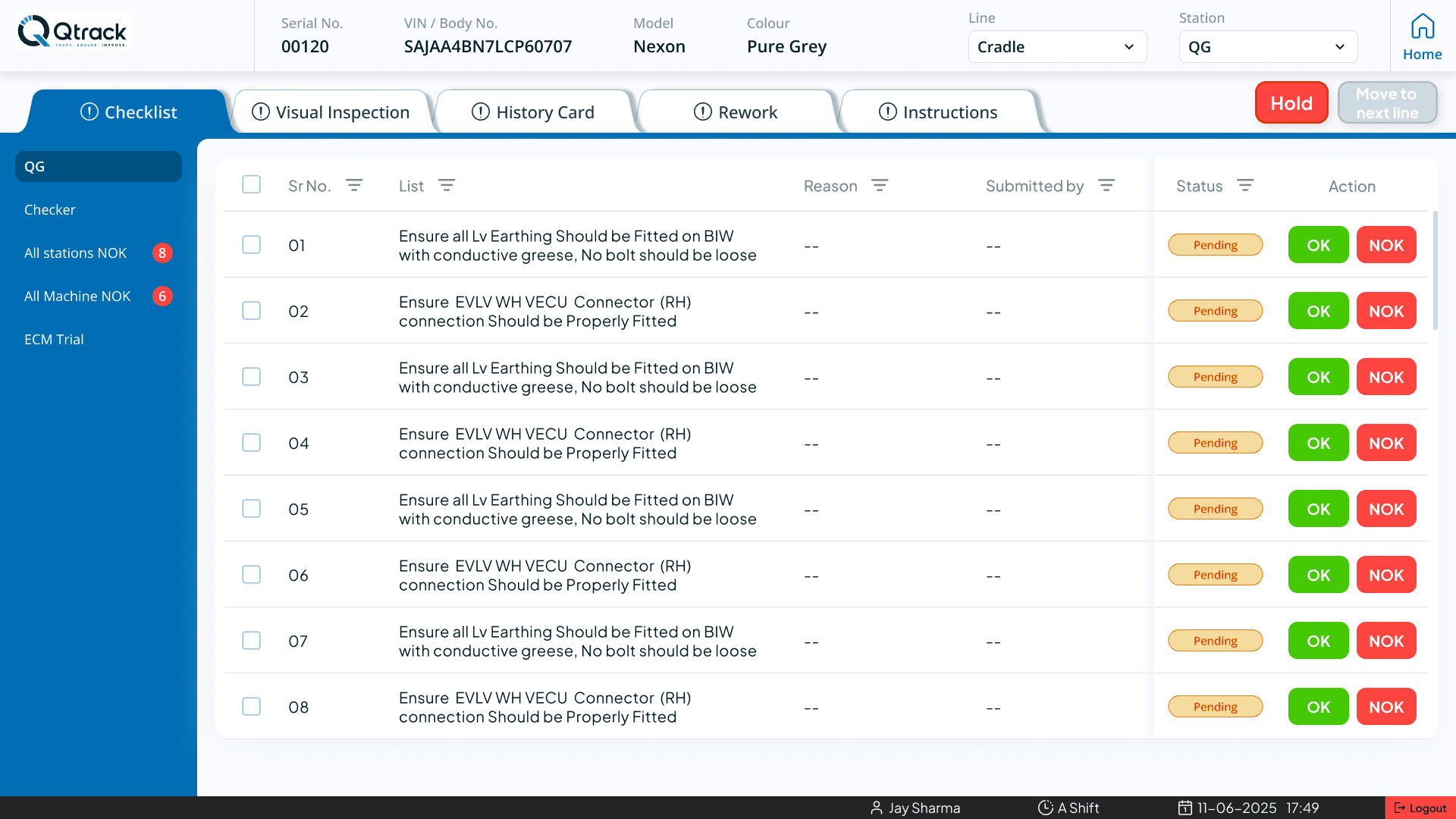
Checklist - Kiosk

Visual Inspection - Kiosk

History Card - Admin
Impact Overview

Digitised the inspection process
Replaced paper-based quality inspections with a connected digital workflow, allowing every inspection to be captured, tracked, and reviewed in one system.
Improved collaboration
Created a structured feedback loop between Makers and Quality Gate inspectors, reducing miscommunication and making issue resolution more transparent.
Increased operational visibility
Enabled supervisors to monitor production status, inspection progress, and quality performance without waiting for manual reports.
Reduced manual effort
Automated inspection records, reporting, and historical tracking, eliminating repetitive paperwork and improving traceability.
Built for scale
Designed a flexible quality management platform capable of supporting additional production lines, inspection templates, and manufacturing processes as operations grow.